📋 Install Mavens — Caregiver Home Safety Checklist | Print or save as PDF to use in your home
InstallMavens
Caregiver Home
Safety Checklist
A room-by-room assessment tool for families, caregivers, and aging-in-place specialists. Complete all sections, score your home, and identify priority modifications that protect your loved one's independence and safety.
© 2026 Install Mavens · theinstallmavens · installmavens.com
Priority key:
| Safety Item | Why It Matters | Priority | Safe? |
|---|---|---|---|
Grab bars installed at toilet Assists with sit-to-stand transfers; reduces fall risk by up to 60% | Falls during toilet transfers are among the most common bathroom injuries for adults 65+ | 🔴 Critical | Yes No |
Grab bars installed in shower or tub Provides support during entry, exit, and while bathing | Standard towel bars are not weight-bearing — they will pull from the wall under pressure | 🔴 Critical | Yes No |
Non-slip bath mat inside tub/shower Prevents slipping on wet surfaces | Wet tile is one of the most hazardous surfaces in any home for older adults | 🔴 Critical | Yes No |
Non-slip rug or mat on floor outside tub Catches water drips; provides stable stepping surface | Wet floors outside the tub/shower cause as many falls as surfaces inside | 🔴 Critical | Yes No |
Raised toilet seat or comfort-height toilet Reduces the distance to sit and rise; easier on knees and hips | Standard toilet height (15") requires significant leg and core strength; comfort height (17–19") reduces strain | 🟡 High | Yes No |
Walk-in or roll-in shower access Eliminates tub step-over hazard; accommodates wheelchairs and walkers | Stepping over a tub ledge is among the highest fall-risk activities for adults with mobility limitations | 🔴 Critical | Yes No |
Shower seat or bench available Allows bathing while seated; reduces fatigue and fall risk | Essential for anyone with limited stamina, balance issues, or lower extremity weakness | 🟡 High | Yes No |
Handheld showerhead installed Allows bathing while seated; reduces overhead reaching | Handheld showerheads are low cost (~$30–$80) and significantly increase bathing independence | 🟢 Moderate | Yes No |
Hot water heater set to 120°F or below Prevents scalding — older adults and those with neuropathy cannot detect dangerously hot water | Scalding burns occur within seconds at 140°F; older skin is significantly more vulnerable | 🔴 Critical | Yes No |
Adequate lighting at night (nightlight or motion sensor) Illuminates path for nighttime bathroom trips | Nighttime bathroom trips account for a disproportionate number of serious falls; darkness is a preventable risk factor | 🔴 Critical | Yes No |
| Safety Item | Why It Matters | Priority | Safe? |
|---|---|---|---|
At least one zero-step or ramped entrance Allows entry without stepping up over a threshold | Required for wheelchair and walker use; also benefits anyone with reduced hip flexion or balance | 🔴 Critical | Yes No |
Ramp (if steps at entrance) is slip-resistant Prevents slipping in rain, frost, or debris | A smooth ramp in wet conditions is more dangerous than the original steps it replaced | 🔴 Critical | Yes No |
Doorways are at least 32" wide (36" preferred) Allows wheelchair and walker passage | Standard doorways (28–30") do not accommodate most wheelchairs; ADA recommends 36" minimum for accessibility | 🟡 High | Yes No |
Door handles are lever-style (not round knobs) Operable with a fist, elbow, or limited hand strength | Round knobs require grip strength and wrist rotation that is often lost with arthritis or stroke | 🟢 Moderate | Yes No |
Entry area is well-lit (interior and exterior) Allows safe navigation at all hours | Poor lighting at entrances causes both falls and security risks; motion-activated lights are low-cost and effective | 🟡 High | Yes No |
Handrail present on all entry steps Provides stability when steps cannot be eliminated | Even one or two steps pose significant fall risk without a stable handrail to grip | 🔴 Critical | Yes No |
| Safety Item | Why It Matters | Priority | Safe? |
|---|---|---|---|
Handrails on BOTH sides of all staircases Bilateral support for safe stair navigation | A single handrail only protects one side; bilateral rails allow continuous grip throughout the entire staircase | 🔴 Critical | Yes No |
All stairs are uniform height with no uneven risers Unexpected height changes cause missteps and falls | The brain adapts its gait pattern to stair height — a single irregular step breaks that pattern and causes falls | 🔴 Critical | Yes No |
Stair edges are clearly visible (contrasting tape or color) Helps those with low vision clearly see each step edge | Step edges are the #1 misstep location on stairs; high-contrast marking adds a critical visual cue | 🟡 High | Yes No |
Stair lift installed (if multi-story home with limited mobility) Eliminates stair navigation entirely for those who cannot safely climb stairs | A stair lift restores full home access; without one, upper floors become inaccessible and bedrooms may need to be relocated | 🔴 Critical | Yes No |
Hallways are at least 36" wide and free of clutter Allows walker and wheelchair navigation; prevents trip hazards | Narrow hallways force assistive device users to tilt or drag devices, which increases fall risk and causes damage | 🟡 High | Yes No |
Motion-sensor lighting on all staircases Illuminates automatically at night without requiring light switches | Reaching for light switches at the top or bottom of stairs is itself a fall risk; automatic lighting eliminates this hazard | 🔴 Critical | Yes No |
| Safety Item | Why It Matters | Priority | Safe? |
|---|---|---|---|
Bed is at a safe, accessible height (knee level) Allows safe sit-to-stand transfers without excessive strain | Beds that are too low (under 18") or too high (over 23") significantly increase fall risk during transfers | 🟡 High | Yes No |
Bed rail or grab bar accessible from bed Provides support for repositioning and getting in/out of bed | Many falls occur when attempting to get out of bed at night; a nearby support surface dramatically reduces this risk | 🟡 High | Yes No |
Nightlight or lamp within reach from bed Enables safe navigation to bathroom at night without full light | Getting up in the dark is one of the most common fall scenarios for older adults; illumination is the simplest prevention | 🔴 Critical | Yes No |
Phone or medical alert device within reach from bed Allows calling for help without needing to get up or walk | If a fall or medical event occurs overnight, the ability to call for help immediately is life-saving | 🔴 Critical | Yes No |
Clear, unobstructed path from bed to bathroom Prevents tripping over furniture, cords, or clutter at night | Even a familiar bedroom becomes hazardous when navigated in low light with reduced alertness | 🟡 High | Yes No |
| Safety Item | Why It Matters | Priority | Safe? |
|---|---|---|---|
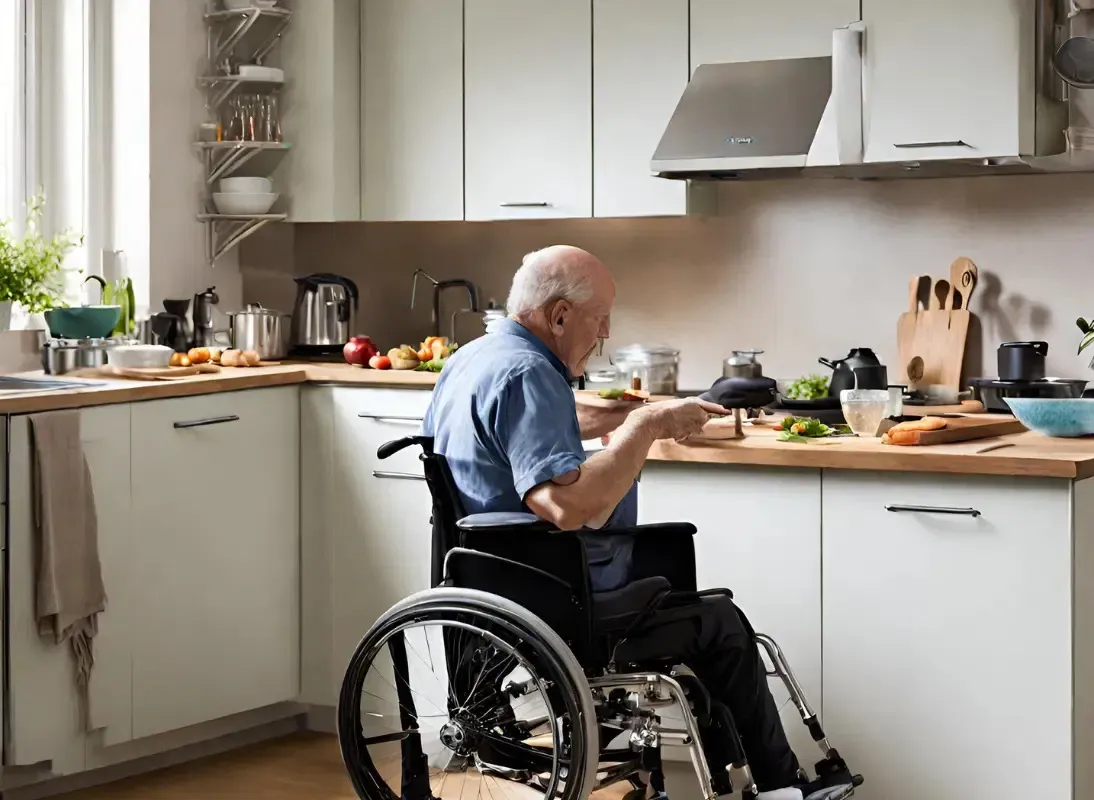
Frequently used items stored at waist height Eliminates overhead reaching and floor-level bending hazards | Reaching overhead or bending to floor level are two of the most common causes of kitchen falls and back injuries | 🟡 High | Yes No |
Lever-style faucet (not cross-handle) Operable with minimal grip strength; easier for arthritis | Cross-handle faucets require grip, pinch, and rotation — all movements compromised by arthritis or stroke | 🟢 Moderate | Yes No |
Stove auto-shutoff device installed (if dementia present) Automatically turns off burners if unattended for a set time | Kitchen fires caused by forgotten burners are a leading cause of home fires involving older adults with cognitive impairment | 🔴 Critical | Yes No |
Pull-out shelves or lazy Susans in lower cabinets Eliminates need to reach deep into low cabinets | Kneeling or bending deeply into low cabinets is a common mechanism of falls and back injuries in the kitchen | 🟢 Moderate | Yes No |
| Safety Item | Why It Matters | Priority | Safe? |
|---|---|---|---|
All throw rugs and area rugs removed or secured Loose rugs are the #1 household trip hazard for older adults | The CDC identifies loose rugs as among the most preventable home fall hazards; removal is free and immediate | 🔴 Critical | Yes No |
Electrical cords do not cross walking paths Cords crossing floors create invisible trip hazards | Power and extension cords that cross pathways are invisible to individuals watching where they step — especially in low light | 🔴 Critical | Yes No |
Light switches accessible at both ends of all hallways Eliminates walking in darkness to reach a switch | Walking to a light switch in the dark is itself a fall risk; three-way switches or smart lighting remove this hazard entirely | 🟡 High | Yes No |
Smoke and carbon monoxide detectors on every floor Life-safety requirement for all households | Older adults are twice as likely to die in a home fire; working detectors provide the critical warning time needed to escape | 🔴 Critical | Yes No |
Medical alert system (wearable) in place Enables calling for emergency help after a fall or medical event | Up to 50% of older adults who fall cannot get up without help; a wearable alert system provides access to emergency response within minutes | 🟡 High | Yes No |
Outdoor pathways and driveway are well-maintained Uneven, cracked, or slippery surfaces cause falls before the person even reaches the home | Falls on outdoor surfaces frequently occur when transitioning between the vehicle and the home entrance | 🟡 High | Yes No |
How to Use Your Results
5 or more "No" answers in any section
This area requires immediate professional assessment. Contact Install Mavens today for a free in-home safety evaluation. Do not delay addressing critical items.
3–4 "No" answers in any section
Your home has moderate safety gaps. Schedule a professional assessment within 30 days and begin with the Critical-priority items first to reduce the highest risks immediately.
0–2 "No" answers across all sections
Your home is relatively safe. Continue monitoring annually as needs change, and address any remaining moderate-priority items at your earliest convenience.
Assessment Notes & Observations
Use this space to record specific concerns, measurements, or questions to discuss with your Install Mavens specialist.
Ready for a Professional Assessment?
Our certified aging-in-place specialists will walk your entire home, review this checklist with you, identify every safety gap, and provide a prioritized modification plan — with funding options included. There is no cost and no obligation.